

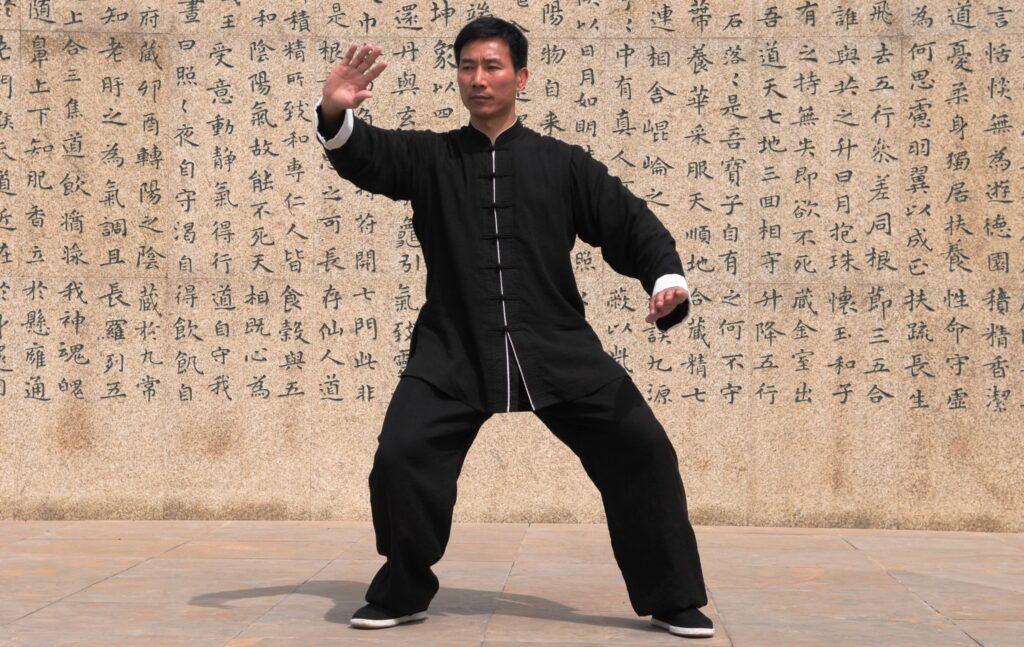
While practicing the Chinese martial arts, as students, we come across different movements which according to the traditional teachings have a name. Some are simple but others very complex, some are funny to our western ears while others make us wonder why were they named as such.
This question was generated during my last visit to Chenjiagou, the birth place of tai ji quan while my teacher was showing me a sword move and he told me it is like the story. I just stood there looking at him with a big question mark on my face and that was passed on to him, find it almost impossible that I didn’t know the story or the meaning …
Starting from today, I will present a number of articles for the friends of Chen style Tai Ji Quan trying to find the roots and explain the meaning behind those moves, helping us understand better the move itself and connect to the cultural background of the Chinese ancestors who named the moves and were passed down to us.
Usually, names are chosen by some of the earliest teachers of a style, if not the progenitor, and then passed on as legacy to future generations. Typically, the names are meant to be descriptive to the students, so they will pass on at least some understanding as to what the move is and / or how it is done. Sometimes an element of poetry has been added. Sadly, much of this descriptive nature is often lost as technology and society evolves, leaving us with names that mean essentially nothing to us, especially in the west.
A perfect example is “silk reeling” which is a core exercise to Chen style. Chán sī jìn (纏絲勁) is not easily translated but refers to the development of a spiral (helical) refined force and the ability to direct that to a point of application. Chán sī gōng (纏絲功), literally, chan si work, refers to performing solo training exercises aimed at learning and improving one's understanding and ability to perform silk reeling.
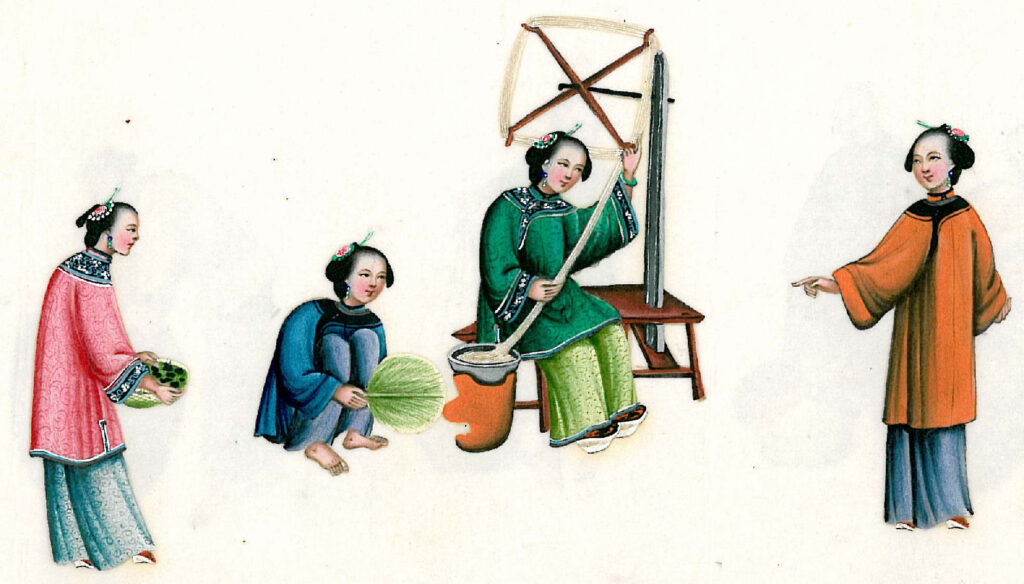
A student is expected to learn to apply the principle of silk reeling to essentially every movement they make in all their martial movement. However, it can take students months, if not years, to start to understand what is meant by this esoteric term.
There was a time however, when the largely rural, peasant population of China understood what silk reeling meant, because it was descriptive of a movement used in the manual production of silk, one of the primary industries of China in early times. By referring to the principle with a descriptive name that the people of the time understood, they also immediately understood some fundamentals of the idea and the movement.
Of course, you, the modern reader, likely have no idea what is meant by silk reeling, and just like most students, you might start to understand after much practice.
The traditional names are fun because they are historically and culturally interesting. Sometimes they still convey meaning. It is the job of a good teacher to analyze and explain the names of each movement so the student can relate and make his/her work easier and more fun as they memorize the move in the sequence of many moves.
After all, as in every art, the students should involve their fantasy in order to relate into a shadow fight that they are engaging themselves while executing the tào lù ( 套路 – sequence of movements in Chinese martial arts).

Η σχολή μας Chen Bing Taiji Academy Αθήνας γιορτάζει τα 5 χρόνια από την εγγραφή…

A short compilation of moves from Lao Jia Yi Lu executed outdoors. Including the elements…

Τον Αύγουστο του 2022 είχα την χαρά και ευχαρίστηση να ταξιδέψω για πρώτη φορά στη…
 EN
EN  EL
EL
Wish and need to learn