

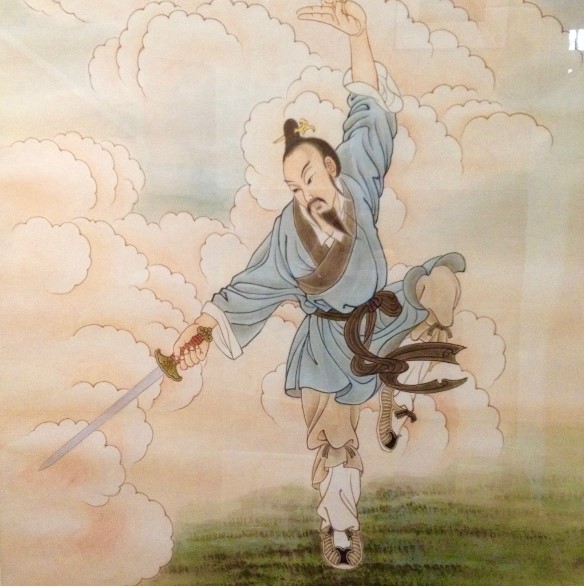
One move that repeats throughout the routine of Chen style Taijijian (straight sword) is called the immortal points the way. As we know the theory of Tai Ji Quan is connected to Daoism (or Taoism) and it is understandable that many of the movement names will be associated with stories and concepts that refer to it. Here bellow you will find a rather long explanation that tries to give you an insight to the theory and the story which may be the origin of the name. Although the text is long, I hope that it will be enriching to your overall taiji experience and I urge you to read it to the end.
The Chinese character for immortal「仙」is composed of the character for person「人」, which transforms into this radical 「亻」when part of another character, and the character for mountain「山」. This has led many to believe that becoming an immortal necessitates retreating into the mountains as a hermit. However, the true meaning is only internal. Becoming an immortal involves ascending one's inner mountain.
Being alone means separating from the ten thousand thoughts. When independent, one is autonomous. The ten thousand thoughts cease, the ten thousand entanglements do not arise. — Liu Yiming, Commentary on Understanding Reality.
You should know the great hermit is concealed in the city; what is the necessity of keeping to tranquil solitude deep in the mountains? — Zhang Boduan, Understanding Reality.
In discussing the trigram Mountain ☶, Liu Yiming said, Mountain represents stopping and stillness. In the body of the trigram, one yang rests on top of two yins ☶ : The yang is above, the yin is below; yang governs yin and yin obeys yang, ensuring that the celestial remains undamaged by the mundane. — Liu Yiming, Commentary on Hexagram #52 Mountain
‘Mountain’ represents the stilling of the monkey mind within oneself. The monkey mind symbolizes the mind incessantly jumping from thought to thought, like a monkey jumps from branch to branch. This concept is illustrated in the story of Journey to the West, when Monkey, who at that time in the story represented the unruly mind, was punished by being trapped under the Five Elements Mountain for 500 years due to his insubordination. Thoughts are like the clouds obscuring one’s inner sun.
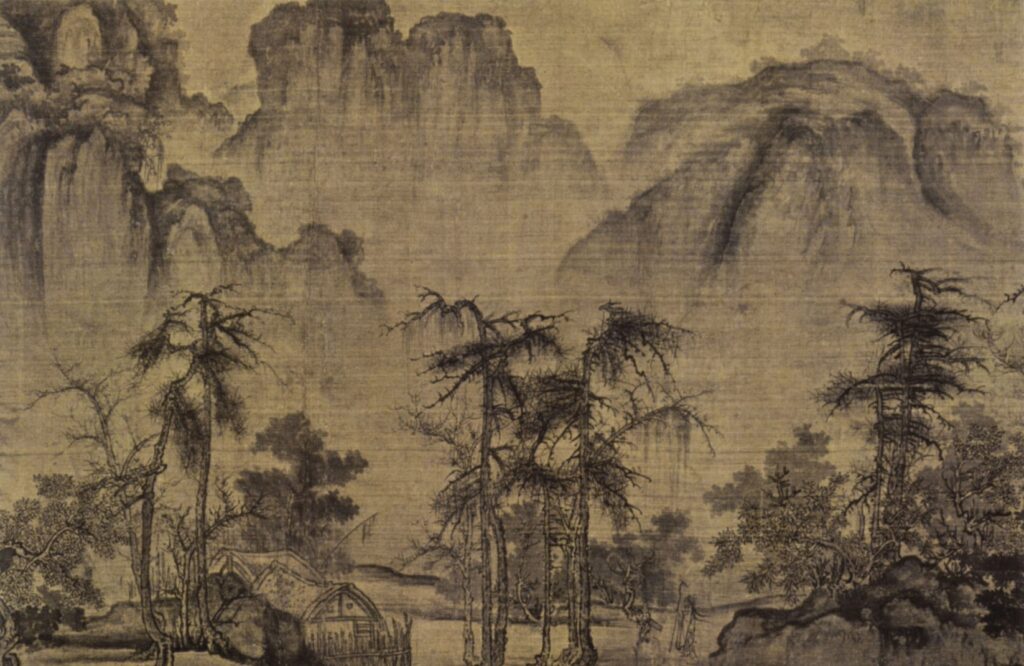
The concept of Xian in Taoism holds a profound place in Chinese cultural and religious traditions. The term "Xian" (仙) is often translated as "immortal" or "transcendent" and refers to beings who have achieved a state of spiritual enlightenment, granting them supernatural abilities and eternal life. These immortals are celebrated for their wisdom, power, and their embodiment of Taoist ideals.
Historically, the pursuit of immortality has been a significant aspect of Taoist practice, dating back to ancient China. The quest for immortality was not merely about living forever but achieving a harmonious state of being that transcends the physical limitations of the human body. This pursuit is evident in various Taoist texts and teachings, including the Tao Te Ching by Laozi and the writings of Zhuangzi.
Laozi, the legendary author of the Tao Te Ching, emphasized the importance of aligning oneself with the Tao (the Way), the fundamental principle that underlies and unites all things in the universe. He stated, "The Tao that can be told is not the eternal Tao; the name that can be named is not the eternal name" (Tao Te Ching, Chapter 1). This aphorism highlights the ineffable nature of the Tao, suggesting that true understanding and alignment with it leads to a transcendent state of being.
Zhuangzi, another prominent Taoist sage, elaborated on the idea of transcendence through his parables and anecdotes. In his eponymous work, the Zhuangzi, he tells the story of the sage Liezi, who could ride the wind effortlessly, symbolizing the freedom and transcendence achieved by those who attune themselves to the Tao. Zhuangzi wrote, "He who knows the joy of the Way lives detached from gain and loss. He dwells in the realms of the immortals."
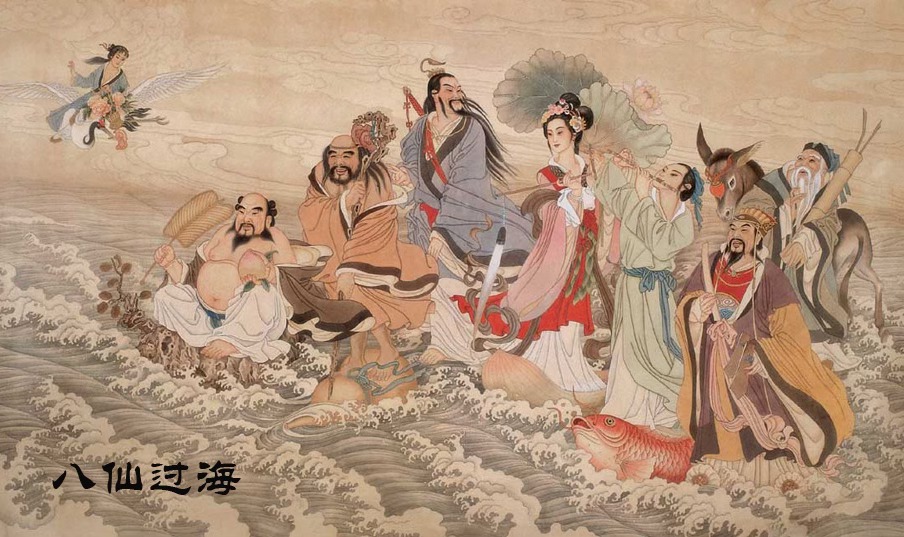
The Xian are often depicted as living in remote, idyllic locations such as the Kunlun Mountains or the Isles of the Immortals (Penglai Islands), far removed from the mundane world. These places are characterized by their beauty, serenity, and abundance, representing the perfect harmony that the immortals have achieved. The lore surrounding the Xian also includes a variety of supernatural abilities, such as flight, invisibility, shape-shifting, and control over the elements.
One of the most famous stories involving the Xian is the legend of the Eight Immortals (Ba Xian). Each of these immortals has unique attributes and represents different facets of Taoist ideals. For example, Lü Dongbin, one of the Eight Immortals, is celebrated for his mastery of alchemy and swordsmanship. He is often depicted with a sword that dispels evil spirits, symbolizing the power of spiritual cultivation to overcome negative influences.
The influence of the Xian extends beyond religious texts and practices. They have permeated Chinese literature, art, and folklore, often serving as symbols of hope, wisdom, and the pursuit of a higher state of being. Their stories have been passed down through generations, continuing to inspire those who seek spiritual enlightenment and harmony with the universe.
Thus, the Xian embody the ultimate goal of Taoist practice: to achieve a state of transcendence and immortality through spiritual cultivation, moral integrity, and a deep understanding of the Tao. Their timeless legacy continues to inspire and guide those on the path of spiritual growth and enlightenment.

Lu Dong Bin is one of the most famous eight gods, so he is often considered the leader of the eight gods. Lu Dong Bin is thought to have lived at the end of the Tang dynasty (618-906) and was born into a humble family. Since childhood, Lu Dong Bin has shown a talent for intelligence and intelligence that far exceeds that of other children his age. When he was a teenager, he decided to follow in his father's footsteps and become a state official.
At that time, to become an official, everyone was required to take a state exam. Unfortunately, Lu Dong Bin did not manage to pass the exam in his first year. Never giving up, he tried to study and work harder, day and night. However, the following year, he failed again. On the way home, he began to doubt his life path to becoming an official. In his doubts, he stopped at an inn and met a fat man who was cooking porridge. The man then offered Lu Dong Bin to sit down and eat a bowl of porridge he was cooking. Lu Dong Bin sat next to the fat man and suddenly felt tired and sleepy. Before long, he fell asleep soundly.
After waking up, the sky was dark and the man was gone. Lu Dong Bin decided to go home. A year after that incident, Lu Dong Bin took the state exam again. This time, he managed to graduate with flying colors and was appointed as a high-ranking state official. Because of his expertise in managing state administration, he was quickly promoted to deputy minister. Then, he married and had two children, a boy and a girl.
Because of his success, a colleague was jealous and accused Lu Dong Bin of corruption. Lu Dong Bin was removed from his position and moved to a remote village. His wife then left him and took his two children away. Lu Dong Bin, who fell into poverty, could only live on the side of the road and huddle in the cold in winter. Feeling that his death had come, Lu Dong Bin closed his eyes and surrendered. At that moment, he woke up because there was a bright light shining on him. He woke up in an inn and was sitting in front of a fat man who was cooking porridge.
The man said: "You have lived your whole life in less time than it takes me to cook a bowl of porridge." Lu Dong Bin, who was shocked, tried to digest the man's words and realized that what he was experiencing was a dream image of his life. Feeling that the man in front of him was a saint, Lu Dong Bin asked what happened. The man then introduced himself by the name Zhongli Quan (one of the eight gods). Lu Dong Bin was determined to follow in Zhongli Quan's footsteps by studying Taoist teachings and seeking the path to perfection. However, Zhongli Quan rejected Lu Dong Bin as his disciple and told Lu Dong Bin to do 3000 virtues first.
Lu Dong Bin lives as a wanderer and always helps people in trouble. On various occasions, Zhongli Quan repeatedly tested Lu Dong Bin's wisdom in living life, from being tricked by a merchant to losing his beloved family. Deemed to have passed the tests given, Zhongli Quan appeared and appointed Lu Dong Bin as a student. Zhongli Quan then taught Taoist philosophy and divine knowledge, so that soon Lu Dong Bin could achieve perfection and become a god.

Στα μέσα του Οκτώβρη 2023 διοργανώθηκε το 1 ο Διεθνές Συνέδριο για τα Κινεζικά στην…

A short compilation of moves from Lao Jia Yi Lu executed outdoors. Including the elements…

Σας παρουσιάζω εδώ ένα βίντεο από την πρόσφατη συμμετοχή μου στην τελετή που έλαβε χώρα…
 EN
EN  EL
EL